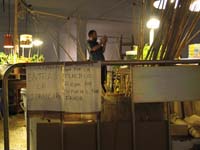
Galleria Metrònom is situated
in an old fruit and vegetable warehouse next to the 19th century
market. The building’s historical role was as a temporary
point of storage, a pause in a process that involved several
different but obviously connected systems. Firstly the agricultural
system of planting, growing and harvesting, which itself exploits
and is dependent on the natural systems – biological,
meteorological etc.; Secondly the economic system of exchange
in the market place; and finally returning to the natural-biological
system of absorption and transference as nutrients in the
human body via the various socio-cultural systems surrounding
the preparation and consumption of food.
The Lladres de cosses exhibition brief spoke of ‘site-specific
multi-media installations’ and a desire for projects
that ‘transcend the physical space of Metrònom
and enter the outside world.’ It was therefore an obvious
choice to consider the use of vegetable produce and the process
of production and consumption, as outlined above, as a starting
point.
It is not hard to question the motives of the agro-industrial
system of production that caters for the vegetable needs of
the urban first world today. In terms of ecology, health and
human rights, the industry has a poor record. From deforestation
to the exploitation of migrant workers, from the driving of
small farms out of business through price fixing and the copyrighting
of GM seed, to the dumping of excess produce on third world
markets.
To take this view on the subject is to take a political position.
Yet in these post-modern, ‘post historical’ times
the ‘death of ideology’ is a given, and the idea
of progressive politics is highly unfashionable, if not highly
suspect. When nearly any form of protest or dissent is almost
instantly co-opted or appropriated by a consumerist mass culture,
is the only creative option to lapse into knowing irony and
go shopping?
***
In 1934 when Metrònom was probably still full of fruit
and vegetables from the fields of Catalunya, Pablo Neruda
was briefly the Chilean consul in Barcelona before being moved
to Madrid the following year. In 1936 the Spanish civil war
broke out and in 1937 España en el corazón was
first published. A year later it was printed in an old monastery
in the thick of the fighting on the eastern front near Girona.
…..
Todo
era grandes voces, sal de mercaderías,
aglomeraciones de pan palpitante,
mercados de mi barrio de Arguelles con su estatua
como un tintero pálido entre las merluzas:
el aceite llegaba a las cucharas,
un profundo latido
de pies y manos llenaba las calles,
metros, litros, esencia
aguda de la vida,
pescados hacinados,
contextura de techos con sol frío en el cual
la flecha se fatiga,
delirante marfil fino de las patatas,
tomates repetidos hasta el mar.
Y una mañana todo estaba ardiendo
y una mañana las hogueras salían de la tierra
devorando seres,
y desde entonces fuego,
pólvora desde entonces,
y desde entorches sangre. 1
Neruda’s poetry was always rooted in a universal idea
of nature but his experience in Spain was to politicize him
and his poetry and he later came to consider poetry as a social
act. España en el corazón and later works were
to become works of political propaganda as well as poetry.
In relation to the Lladres de Cosses project Neruda can be
seen to represent an historical example of the artist and
his work moving from the sphere of culture in to the social
and political spheres. In particular his poetry was seen as
part of an international struggle against Fascism, and in
support of the people, “…the people whose sword,
whose handkerchief my humble poetry wants to be, to dry the
sweat of it’s sorrows and give it a weapon in its struggle
for bread.” 2
Later, in 1954 he wrote Odes Elementales “… a
homage to daily living and ordinary people” in an attempt
to “…suggest an art as close as possible to life.
They celebrate bread, wood, tomatoes, the weather, [….]
Neruda’s ordinary people belong to some stage before
the conveyor belt and the assembly line. They are sailors,
bricklayers, miners, carpenters or bakers – all those
whose work involves the handling of primary materials. The
odes restore a sense of the wholesomeness of work and at the
same time suggest that Neruda’s utopia is perhaps not
very different from the community in which he grew up.”
3
In 1969 Neruda became the communist party candidate for the
presidency of Chile and was active in the formation of the
Popular Unity Party (PUP). He later stood down to allow Salvador
Allende to become the party’s sole candidate. In September
1973 the democratically elected PUP was overthrown in a military
coup d’état led by Augusto Pinochet Ugarte. Allende
was executed at the presidential palace in Santiago and twelve
days later Neruda died. Spain’s dictator was to die
in 1975. In Chile the military regime of Augusto Pinochet
continued into the nineties.
I came across the Selected Poems of Pablo Neruda in the late
eighties when Latin America and revolutionary politics were
important parts of my own life. In October 1989, a year before
the first elections in Chile for twenty years, I cycled over
the Andes from Argentina and down into the Atacama desert
of northern Chile. There were two poems in the selection that
I always returned to: Explico Algunas Cosas from España
en el corazón and Oda al Tomate.
The Tomato: South American native but now a significant part
of the vegetable culture of Catalunya, I believe.
***
The project ‘Model Farm’ has developed from these
historical and personal connections using a working method
that embraces the elements of chance, intuition and free association.
Although my work could be said to be about a search for meaning,
I am not seeking to provide answers in any didactic way. I
am more interested raising questions, or setting up situations
that hold the possibility of meaning being revealed through
the interaction of an audience.
I come to Barcelona a stranger. My countries cultural history
is one in which civil war and dictatorships have not played
a part in living memory. I find myself having to confront
a context and history I know little about. For me, one of
the enduring narratives of the civil war in Spain is that
of the mobilisation of artists against the forces of fascism.
The myth of their heroic defeat remains. Laurie Lee, the English
poet who lived a few miles from where I now live, made much
of his involvement in the international brigade’s fight
for freedom. Critics now cast serious doubts about the reality
of the tales he told of his exploits in 1930’s Spain.
But the need to mythologies the past, like the desire to idealise
a future, is not only the prerogative of poets. I am here
in Barcelona to present a project that will reflect and comment
upon the situation and context that I find here. Yet culturally
I am positioned outside of the context I am having to engage.
Like Laurie Lee I am in reality a tourist caught up in the
intricacies of a situation of which I can only scrape the
surface. In all areas - language, history, culture - I am
only grasping at understanding. I will work with what I have,
a chance mixture of knowledge, experience and imagination,
but the fallibility of the individual’s attempt to construct
meaning always remains visible. An exploration of this commitment
to lost causes, to the flawed ideal, is an ongoing theme in
this and other works.
As mentioned above to take a view on a subject like modern
agriculture is to take a political position. To stand in opposition
to something necessarily means that one must acknowledge the
possibility of an alterative, even if the alternative is unclear
or absent.
It may be that Neruda’s unreconstructed communist politics
are hard to swallow today. His stance on issues like Soviet
aggression in Eastern Europe did, even to some of his contemporary’s,
seem particularly naïve. When he comes out with a statement
like “Fortunately, my party is not against expressions
of beauty” it is almost laughable. But in a sense it
is also indicative of the problems inherent in trying to integrate
art and politics. Yet by dismissing the naivety of the idealism
of the poet do we risk dismissing the relevance of the struggle
against fascism and the great polemic of the twentieth century?
And although Pinochet is still awaiting a verdict on his role
in the deaths of thousands of Chilean civilians, the prevailing
political consensus in the 21st century seems to be that We
are now above such things. Is it inevitable that because of
the failures of 20th century idealism all alternatives to
the capitalist monoculture are now rendered redundant?
Maybe one of the final arenas in which we can explore these
alternative or idealist models is through art. Of course it
is an exploration that has to recognise the privileged yet
impotent position within the mainstream monoculture that art,
stripped of it’s own C20th idealist pretensions, now
occupies.
The Model Farm proposes an alternative or idealistic system
where by the potential consumers of the produce are asked
to share in its production. Unlike the norm of the consumerist
market place the outcome of this process is not dependent
on individual purchasing power but on a collective acceptance
of responsibility. Of course merely stating this does not
guarantee that this ideal will be implemented. I/We cannot
compel Metrònom visitors to subscribe to this idealistic
experiment. But this is part of the process. I am setting
up the situation, not dictating its outcome.
The model can be seen as the antithesis of the agro-industrial
system of production. The installation will echo the vernacular
micro-agriculture of the urban peasant or horticultural squatter.
These semi-urban vegetable gardens can be seen in many peripheral
locations around Barcelona. By referencing this phenomenon
Model Farm also speaks of a contemporary reality as well as
proposing ideal alternatives. In its proposed form the installation
does not present the ideal as a perfect technological future
but as an impoverished, ‘makeshift’ or improvised
version. This imperfect Model highlights the fallibility of
it’s own ideals. Less the grand revolutionary gesture,
more the last ditch attempt to create an alternative space
from the detritus of the hegemonic culture.
Lastly the role of the potential produce as food is a vital
element in the project. The particular social and cultural
space that opens up around the preparation and consumption
of food, especially where these activities are a part of a
voluntary collective process, can be seen as an alternative
to the market driven consensus. The potential that the produce
of the installation will at some point play a part within
a social arena beyond the gallery is to fulfil the ideal of
the Lladres de cosses project. The fact that time is required
for the project’s complete realisation is also important.
During the exhibition this realisation, that is, a feast of
tomatoes, can only be imagined as a potential future, like
a tiny utopian moment. It may be a moment that we may never
reach in reality, but it’s ideal is a possibility that
we can choose to pursue or not.
© Dominic Thomas 2005
1. Explico Algunas Cosas from España en el corazón
2. P. Neruda Memoirs, 1974 (translation 1977)
3. Jean Franco P. Neruda Selected Poems Penguin, 1975
|